
PhD Guide UK
Practical, honest, and supportive content about academic life from a UK-based supervisor and researcher.


Episode 1: The PhD landscape in the UK
The UK PhD process can feel like a maze, but it doesn't have to be. Today, I’m demystifying how PhDs are actually structured in the UK, how the application timeline works, and where to start looking for funding. Whether you're a domestic or international student, this episode will help you get started.

Episode 2: The PhD application process
What makes a PhD application land in the "yes" pile? After reviewing countless submissions, I’ve seen exactly what sets the best apart, and the common mistakes that hold others back. In this episode, I’m sharing the key strengths and weaknesses you need to know before you hit submit.

Episode 3: Why people do a PhD?
Why do people actually put themselves through a PhD? From global travel and career pivots to the thrill of discovering something entirely new, I’m breaking down the top drivers behind people's motivations to do a PhD. Whether you're considering one or already in the thick of it, this episode is for you.

Episode 4: Using AI to conduct interviews
AI-interviewers: A researcher’s best friend or a step too far? Today, I’m breaking down the pros and cons of using AI to conduct interviews. I’ll be sharing specific examples from my own research to show you where this technology shines and where it still falls short.

Episode 5: Phrases every PhD student needs in their thesis
In this episode, we walk through the "28 Academic Phrases Guide" to help you write a clearer, more professional thesis. From "addressing the gap" to "further research is needed," learn how to use these essential templates to structure your chapters and get your thesis going.

Episode 6: Decoding Research Quality in REF - A Phd / ECR perspective
In this episode, we pull back the curtain on the UK's Research Excellence Framework (REF2021), specifically focusing on the Business and Management (B&M) results from Sub-Panel 17. For many PhD students and Early Career Researchers (ECRs), the REF can feel like a "black box," but the latest cycle marks a massive shift toward inclusivity and transparency that you need to know about. We also debunk some of the most unsubstantiated myths around 4* publications.
Episode 7: Stop Filling Gaps
Because 'nobody has studied this before' isn't a research contribution." Most PhD students are taught to find what’s missing—but in 2026, gap-filling is the fastest way to get an "incremental" verdict from reviewers. Join me for an exploration into the scholar mindset, where we ditch the treasure hunt for "missing" pieces and start finding the theoretical tensions that top-tier journals actually care about. If you’re a PhD in social science or business, it’s time to stop filling gaps and start breaking ground.
Episode 8: The Supervisor Bottleneck: Why your proposal is only half the battle?
You have a First-Class degree, a gap in the literature, and a 2,000-word proposal that’s ready to go. You’re the perfect candidate... right?
In this episode, I explore the frustrating reality of the Supervisor Bottleneck. I share some insights on why "capacity" is the most dreaded word in an applicant’s vocabulary and how university policies on PhD quotas can stall even the best projects.
Episode 9: From Life Maps to Screencasts: 6 Creative Data Sources You Need to Try
Are you stuck in a loop of semi-structured interviews? Do you feel like your participants are giving you "scripted" answers instead of their raw, honest experiences?
In this episode of PhD Guide UK, we’re breaking out of the interview box. We explore six innovative qualitative data sources that will help you bypass social desirability bias and get to the heart of your research.
Episode 10: The Path to "Yes" with Guest Rameesha Ahmed
In this episode, I sit down with Rameesha Ahmad to discuss her resilient journey from a string of "nos" to finally securing a PhD position. Rameesha details her methodical application process, beginning in 2023, which involved drafting multiple proposals and managing a rigorous outreach schedule to potential supervisors. This episode highlights the significant hurdles she faced, including the financial and scholarship crisis within the UK higher education sector and the mental health toll of repeated rejections. We also share some useful strategies to navigate this challenging process.
Episode 11: The thesis blueprint
Are you staring at a blinking cursor, wondering if you’re just a "bad writer"? Here’s a secret: Most students don’t struggle with dissertations or their thesis because of their writing skills, they struggle because they treat it like a giant homework assignment instead of an independent research project.
In this episode, we strip away the academic jargon and break down the "core logic" of a thesis. Whether you’re just starting your proposal or you’re deep in the "panic zone" of your final year, this guide will help you stop chasing word counts and start building a defensible argument.
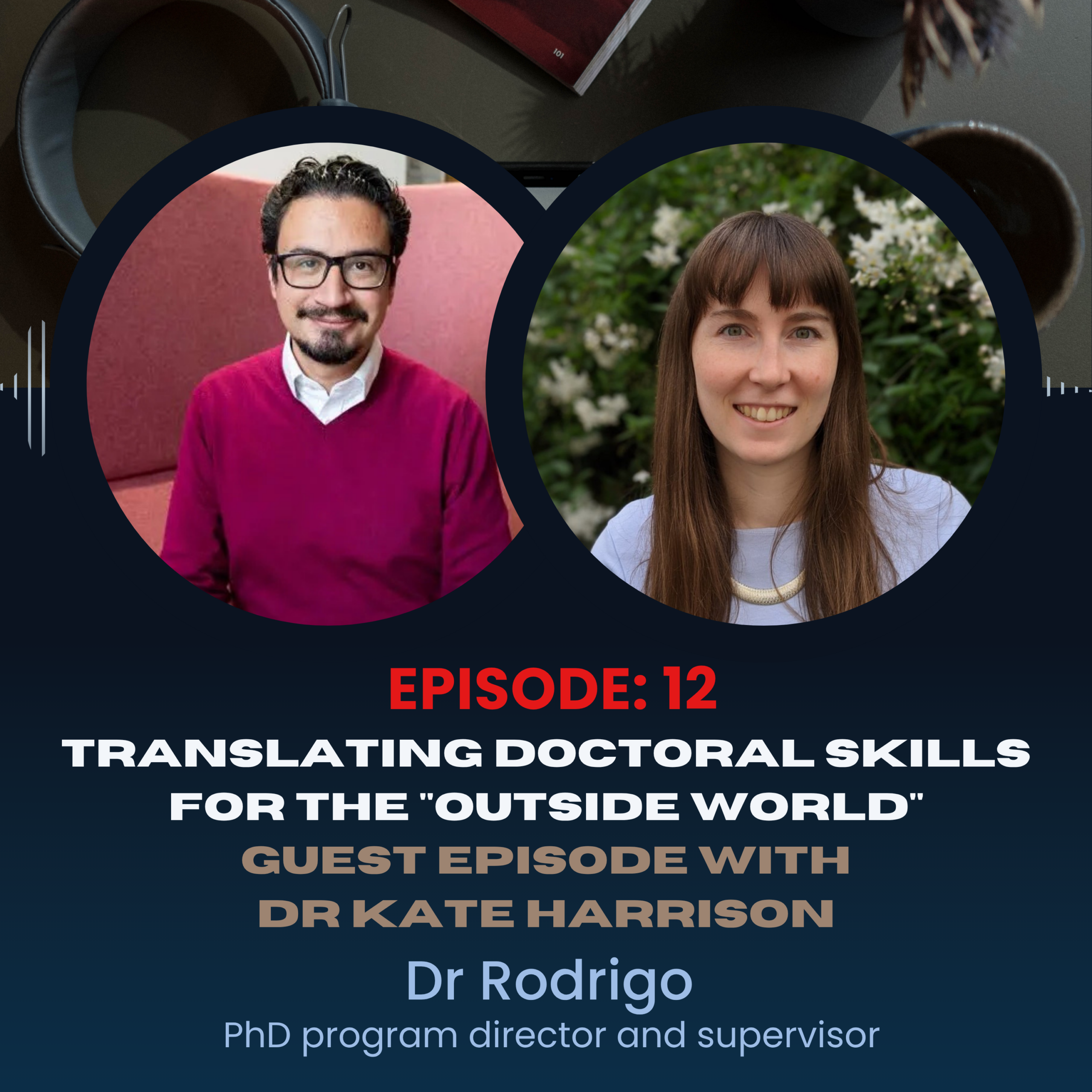
Episode 12: Translating Doctoral Skills for the "Outside World"
What happens when the academic career path you imagined doesn’t align with the impact you want to have? In this episode, PhD Guide UK sits down with Dr Kate Harrison, a Senior Policy Researcher at Citizens Advice, to discuss her journey from the lecture hall to the front lines of policy influence.
Whether you are feeling isolated in your research or curious about how your methods training applies to government and charity sectors, this episode provides a roadmap for turning your academic expertise into a career with real-world influence.
Episode 13: From Student to Staff: The Anatomy of a Winning Academic CV
You’ve spent years writing your thesis; now it’s time to spend twenty minutes writing the document that actually gets you paid for it.
In this episode, we pull back the curtain on the academic hiring process. Having sat on both sides of the interview table for over two decades, I share some insights on what makes a CV land in the "Shortlist" pile versus the "Thank you, but no" pile.
The transition from PhD candidate to permanent staff member requires a radical shift in how you present your work. It’s no longer about what you’ve learned; it’s about what you can deliver. Whether you are aiming for a high-intensity Teaching & Research (T&R) role or a teaching-focused lectureship, this episode is your strategic blueprint.
Episode 14: "You Put My Name, I Put Your Name": Decoding the Authorship Misappropriation Diamond
In this episode, we dive into the systemic issue of authorship malpractice, recently framed in a paper as the "You Put My Name, I Put Your Name" syndrome.
We explore the five prevailing patterns of misconduct identified by this research: transactional authorship, promotion-driven padding, hierarchical patronage, reciprocal name-exchange, and unauthorised inclusion.

Episode 15: Transitioning from Industry Expert to PhD Researcher
What happens when a successful Marketing Director walks away from the fast-paced corporate world to pursue a PhD? In this episode, host Dr Rodrigo Perez Vega sits down with Kamilla Miller, a researcher at Henley Business School, to discuss her radical career pivot.
Kamilla shares her journey from climbing the echelons of industry, from assistant roles at a publishing giant to the high-pressure seat of a Marketing Director. Despite her success, she found herself craving deeper satisfaction and a return to the academic world she had always dreamed of.
In this episode, we dive deep into the "culture shock" of moving from "industry-fast" deadlines to the rigorous, "slow" checks of academic research. Kamilla also pulls back the curtain on her current research: how humans trust (or over-rely on) AI advice and whether these tools actually empower us or diminish our capabilities.
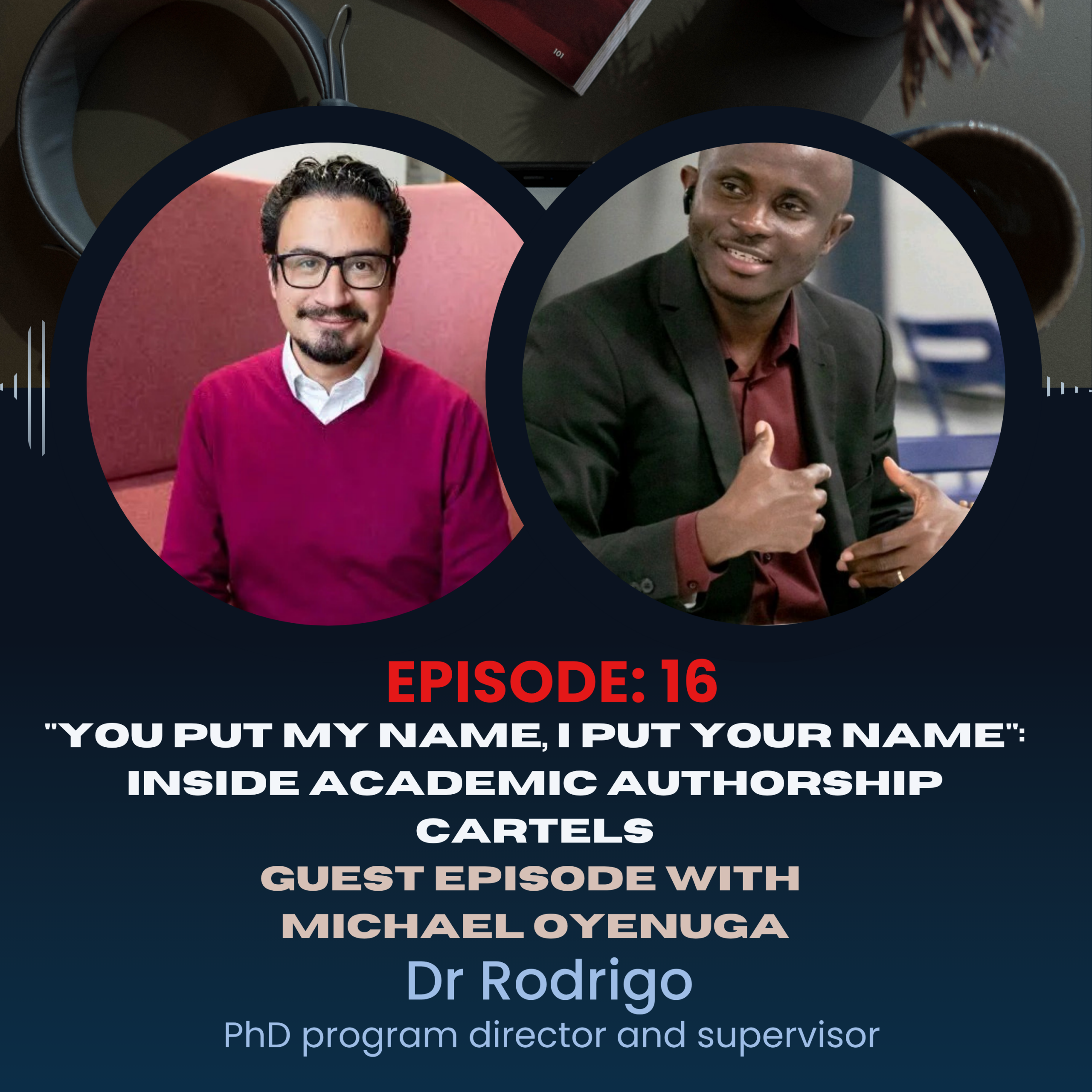
Episode 16: "You Put My Name, I Put Your Name": Exposing Unethical Practices in Academic Publishing with Michael Oyenuga
What happens when the "publish or perish" syndrome forces academics into unethical authorship cartels? In this episode of the podcast, host Dr Rodrigo Perez-Vega sits down with Michael Oyenuga from Woxen University to dissect his viral research paper on academic publishing malpractice. Together, they unmask the global, hidden culture of coerced author credits, supervisor power dynamics, and the hidden systemic pressures plaguing junior researchers and PhD students from the Global North to the Global South.
Michael shares the inside story of how his paper went viral and provides actionable advice for PhD scholars on how to protect their intellectual property when navigating complex institutional hierarchies.
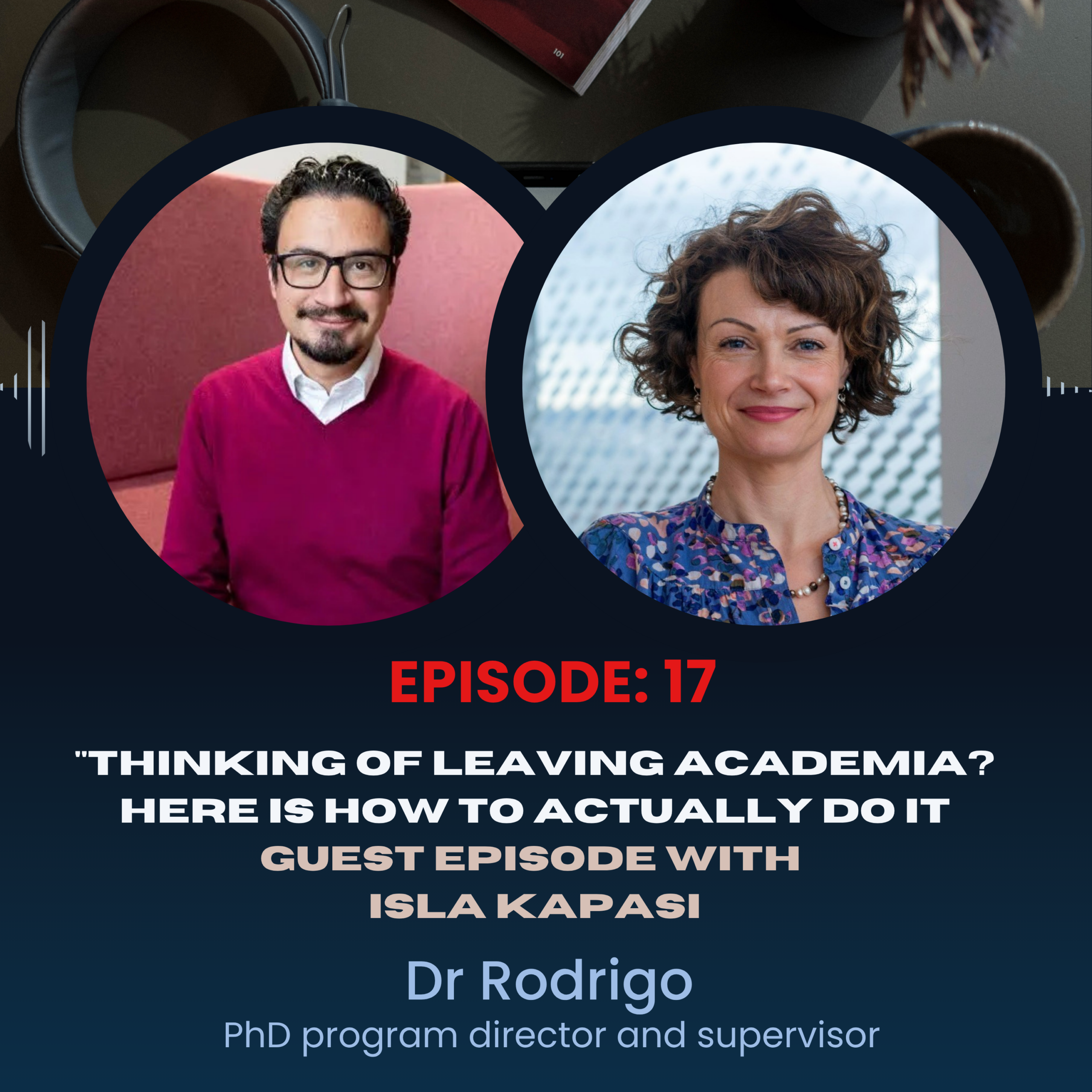
Episode 17: Thinking of Leaving Academia? Here Is How to Actually Do It.
Only 42% of UK PhD graduates stay in higher education after graduation. So why does walking away from the ivory tower still feel like jumping off a cliff without a parachute?
In this episode, I sit down with Dr Isla Kapasi, Head of Research and Evaluation at Zero Waste Scotland, to talk through what really happens when you trade university lectures for more direct impact. Isla shares her journey from academia into policy and circular economy leadership, detailing exactly how PhDs can translate complex scholarly work into commercial return on investment.